
Blog
Best Practices for Peptide Storage — UK Researchers
Published May 5, 2026
Introduction to Laboratory Peptide Stability
In the precision-driven environment of United Kingdom laboratory research, the integrity of biochemical reagents is paramount. Peptides, which are short chains of amino acids linked by peptide bonds, are inherently sensitive to environmental fluctuations. Factors such as temperature, ultraviolet (UV) light exposure, humidity, and pH levels can significantly alter their primary structure. For researchers at academic institutions or private facilities across the UK, maintaining the highest standard of peptide storage is essential to ensure that experimental data remains reproducible and valid. Failure to adhere to rigorous storage protocols often results in the degradation of the compound, leading to skewed results and the unnecessary depletion of research budgets.
Most research peptides sourced in the UK, such as purchased research chemicals, are delivered in a lyophilised (freeze-dried) state. This state is designed to maximise stability during transit and long-term storage. However, once a peptide enters a laboratory environment, its shelf-life becomes a variable dependent on the researcher’s handling procedures. Whether working with metabolic analogues like tirzepatide or regenerative sequences like BPC-157, understanding the thermodynamics of peptide stability is the first step in successful in vitro or in vivo experimentation. This guide outlines the official best practices for the storage and handling of research peptides within the UK regulatory framework, strictly for laboratory use and not for human consumption.
The Physics of Lyophilisation and Pre-Reconstitution Storage
Lyophilisation is a dehydration process typically used to preserve perishable materials. By freezing the material and then reducing the surrounding pressure to allow the frozen water in the material to sublimate directly from the solid phase to the gas phase, the peptide is left in a stable, porous ‘cake’ or powder. In this state, the peptide is significantly less reactive than in a liquid solution. For UK laboratories receiving shipments via Royal Mail or specialised couriers, these vials are generally stable at room temperature for several weeks, but long-term protocols require colder environments.
For short-term storage (less than one month), a standard laboratory refrigerator maintained between 2°C and 8°C is sufficient for lyophilised vials. However, for longitudinal studies where peptides may not be used for several months or years, a freezer set to -20°C is the gold standard. In cases where extreme longevity is required (exceeding two years), ultra-low temperature freezers at -80°C are recommended. It is vital to ensure that freezers are ‘non-frost-free,’ as the temperature cycling in frost-free units can lead to subtle moisture accumulation and thermal stress, potentially compromising the peptide’s delicate side chains.
Managing Environmental Variables: Light and Humidity
Temperature is not the only catalyst for peptide degradation. Photolysis, or the degradation of molecules by light, is a significant risk for certain amino acids such as tryptophan, tyrosine, and phenylalanine. When exposed to intense UV or even ambient laboratory fluorescent lighting, these residues can undergo oxidation. Therefore, peptides should always be stored in amber vials or wrapped in aluminium foil if the primary container is clear. Within a UK lab, keeping vials inside their original cardboard boxes or dedicated dark storage bins is a simple but effective measure to prevent light-induced damage.
Humidity is perhaps the most insidious threat to lyophilised peptides. Peptides are often hygroscopic, meaning they readily absorb moisture from the atmosphere. When a vial is opened or if a seal is improperly crimped, atmospheric moisture can enter, causing the ‘cake’ to collapse and promoting hydrolysis. Hydrolysis is a chemical reaction where water breaks the peptide bonds, effectively destroying the sequence. Researchers should always allow vials to reach room temperature before opening or piercing the septum. This prevents the condensation of atmospheric moisture onto the cold powder, a critical step often overlooked in fast-paced research environments.
Reconstitution Protocols and Bacteriostatic Water
The transition from a lyophilised powder to a liquid solution is the point of greatest risk for a research peptide. In the UK, the standard solvent for research peptides is Bacteriostatic Water (0.9% benzyl alcohol). The inclusion of benzyl alcohol serves as a preservative, inhibiting the growth of most potentially contaminating bacteria. While sterile water can be used for single-use applications, it lacks the antimicrobial properties required for multi-draw vials. Once reconstituted, the peptide is in its most vulnerable state, as the protective effects of the lyophilised lattice are gone.
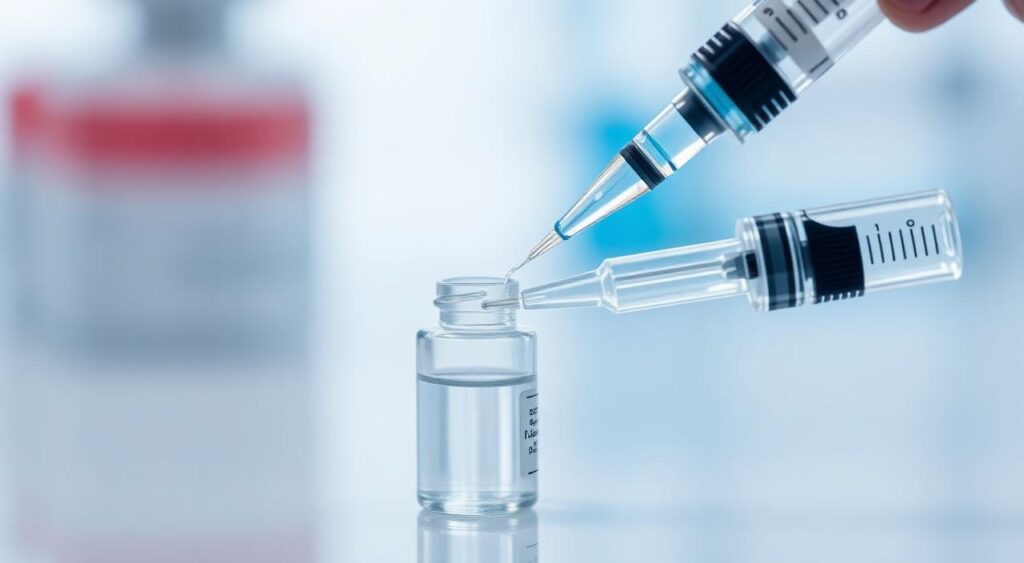
When introducing the solvent, it should be done with care. The vacuum present in many professional peptide vials can cause the water to rush in violently, potentially shearing the peptide molecules through mechanical stress. It is recommended to aim the needle at the glass wall of the vial, allowing the solvent to trickle down slowly. Rather than shaking the vial, which can cause denaturing and foaming (especially in larger proteins), a gentle swirling motion should be used until the solution is clear. If a solution remains cloudy after gentle agitation, this may indicate that the peptide has reached its solubility limit or that the pH of the solution is near the peptide’s isoelectric point.
Mathematical Accuracy: A Reconstitution Example
To ensure precise experimental dosages, researchers must master the mathematics of dilution. Using a peptide reconstitution calculator is highly recommended to avoid manual errors. Below is a worked example often used in UK laboratory training modules for a hypothetical compound.
Scenario: A researcher has a 5mg vial of research-grade semaglutide and requires a concentration that allows for a 250mcg dose to be easily measured in a standard U-100 (1ml) syringe.
- Total Peptide Weight: 5mg (5,000mcg).
- Solvent Volume: 2ml of Bacteriostatic Water.
- Resulting Concentration: 5,000mcg / 2ml = 2,500mcg per ml.
- Syringe Calibration: A U-100 syringe has 100 units per 1ml. Therefore, 2,500mcg / 100 units = 25mcg per unit.
- Target Dose: To achieve a 250mcg dose, the researcher must draw 10 units (0.1ml) of the solution.
Maintaining a digital or physical log of these calculations, including the date of reconstitution and the volume of solvent added, is a standard requirement for maintaining GLP (Good Laboratory Practice) in the UK.
Storage of Reconstituted Peptides: The 28-Day Rule
Once a peptide has been reconstituted, its shelf-life drops from years to weeks. Most peptides in solution should be stored at 2°C to 8°C. They should never be frozen again once they have been dissolved, as the formation of ice crystals can physically shear the peptide chains, particularly in longer sequences like sermorelin or GHRH analogues. For most biochemical research applications, the ’28-day rule’ is applied. This rule, influenced by MHRA guidelines for multi-dose vials, suggests that the preservative effectiveness of bacteriostatic water and the chemical stability of the peptide cannot be guaranteed beyond 28 days of the first puncture.
Stability varies significantly between sequences. For instance, smaller, more robust peptides like BPC-157 may remain stable for up to 8 weeks if kept refrigerated and protected from light. Conversely, more complex or fragile sequences might begin to degrade within 14 days. If a researcher notices any change in the clarity of the solution, the presence of particulates (‘floaters’), or a change in colour, the vial should be disposed of according to the laboratory’s hazardous waste protocols. It is also important to note that repeated piercing of the rubber stopper can introduce microscopic debris or compromise the sterile seal, further necessitating the 28-day replacement cycle.
Transport and Shipping Considerations within the UK
When moving peptides between UK facilities or receiving them from a supplier, the ‘cold chain’ is a frequent concern. While lyophilised peptides are remarkably resilient to the 24-48 hour transit times associated with Royal Mail Tracked 24 or similar express services, extremes of heat must be avoided. During the summer months, it is advisable for laboratories to request insulated packaging or gel packs for sensitive compounds. However, for most of the year in the UK, ambient temperature transit does not significantly impact the efficacy of un-reconstituted peptides.
If a researcher needs to transport a reconstituted peptide (for example, between two wings of a university or to a different campus), it should be kept in a portable cool-box with a temperature monitoring device. Mechanical agitation—such as the vibration from a vehicle or even vigorous walking—should be minimised. Peptides are delicate; the kinetic energy from constant shaking can leads to aggregation, where the peptide molecules clump together and lose their biological activity. For more information on the regulatory environment of these compounds, researchers should consult the guide on peptide legality in the UK.
Waste Management and Laboratory Safety
The disposal of research peptides and the paraphernalia used to handle them (syringes, needles, glass vials) is strictly regulated in the UK under the Environmental Protection Act 1990 and the Hazardous Waste Regulations. Even though these substances are for laboratory research use only and not for human consumption, they are treated as chemical or biohazardous waste. Sharp objects must be placed in a yellow ‘sharps’ bin, which is then collected by a licensed waste disposal contractor.
Any unused peptide solution should be neutralised if necessary, though most small-scale research volumes are disposed of via chemical waste streams. Vials should be de-labelled or marked clearly as ‘waste’ to prevent accidental reuse. Maintaining a clean workspace, utilising 70% isopropyl alcohol for surface sterilisation, and wearing appropriate PPE (gloves, lab coat, eye protection) are non-negotiable standards when handling these concentrated biochemical agents. Every UK lab should have a standard operating procedure (SOP) that covers both the storage and the eventual disposal of these substances to ensure compliance with local health and safety executive (HSE) requirements.
Frequently Asked Questions
Can I store reconstituted peptides in the freezer to make them last longer?
No, it is highly recommended that you do not freeze peptides once they have been reconstituted with bacteriostatic water or sterile water. The process of freezing and thawing creates ice crystals that can break the peptide bonds and cause mechanical degradation. Reconstituted peptides should be stored in a refrigerator at 2°C to 8°C. Only lyophilised (powder) peptides should be stored in the freezer for long-term preservation.
What happens if I accidentally leave my peptide vial at room temperature?
If the peptide is in its lyophilised powder form, leaving it at room temperature for a short period (a few days to a week) is unlikely to cause significant degradation, provided it is out of direct sunlight. However, if the peptide has already been reconstituted, leaving it at room temperature for more than a few hours can significantly accelerate the rate of bacterial growth and chemical breakdown. In such cases, the integrity of the research may be compromised, and a new vial should be prepared.
Is it necessary to use Bacteriostatic Water, or is Sterile Water okay?
For most UK research applications involving multi-draw vials, Bacteriostatic Water is the preferred choice because it contains 0.9% benzyl alcohol, which prevents bacterial contamination for up to 28 days. Sterile Water (Pure Water) does not contain any antimicrobial agents; therefore, once the vial is punctured, there is no protection against contamination. Sterile water is typically only used for single-use vials that are disposed of immediately after the first draw.
How can I tell if a peptide has degraded or ‘gone bad’?
Visual inspection is the first line of defence, though it is not foolproof. If a solution that was previously clear becomes cloudy, develops sediment, or changes colour, it is a definitive sign of degradation or contamination. However, many peptides can lose their biological activity through subtle structural changes that are not visible to the naked eye. This is why adhering to strict storage timelines (refrigerated for 28 days) and temperature controls is essential for ensuring experimental consistency in the lab.